resource / Guide
Does privacy window film work at night?
Window film
Guide
9 min read
2026-05-13

If you want privacy window film that lets you see out but not in at night, the honest answer is that not all film types can do it. One-way reflective film provides daytime privacy but loses its effect after dark. When the lights inside a room are brighter than outside, the mirror effect reverses and anyone standing outside can see straight in. For reliable 24/7 privacy, frosted, reeded, blackout, or whiteout film is the right choice.
Key Takeaways
- Reflective one-way film depends on a light differential to work. It loses its privacy effect at night when the interior is brighter than outside.
- Frosted window film is the most practical solution for 24/7 privacy in bathrooms, meeting rooms, offices, and glass partitions.
- Reeded and fluted glass film provides a design-led alternative that works day and night without blocking light.
- Blackout and whiteout films offer complete opacity for spaces where no visibility is acceptable at any time.
- For commercial spaces occupied after dark, specifying the right film matters. A site survey helps confirm the correct option before installation.
Why one-way reflective film loses privacy after dark
Reflective and mirrored privacy films work because of a difference in light levels on either side of the glass. During the day, the outside is significantly brighter than the inside. The reflective coating bounces that exterior light back at anyone looking in, creating a mirror effect that prevents them from seeing through.
The general rule of thumb used in the industry is that the exterior needs to be at least three times brighter than the interior for the film to work effectively.
Once that balance tips, so does the privacy.
When you switch the lights on in the evening, the inside of the room becomes brighter than the dark street or garden outside. The reflective effect now works against you. Instead of reflecting external light back, the film transmits internal light outward. To someone outside, the glass looks like a lit window - and they can see in clearly.
Take a typical office building. During the working day, street-facing windows treated with a reflective film give staff a clear view out while preventing passers-by from looking in. But when the team stays late for a meeting and the overhead lights are on, those same windows offer almost no privacy at all. Anyone walking past can see straight through.
This isn't a flaw in the product. It's a physical limitation of how reflective film works, and any installer or supplier who doesn't explain it clearly is doing their customer a disservice.
Which types of window film do work at night?
Several film types provide reliable privacy regardless of whether the lights are on or off, because they do not rely on a light differential at all.
Frosted window film
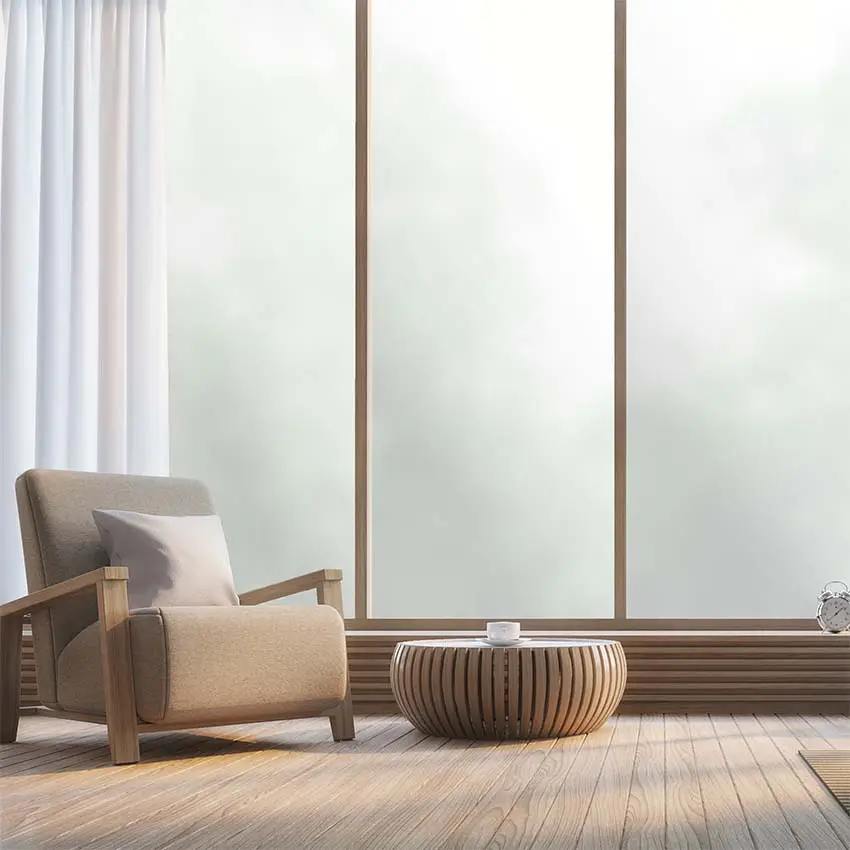
Frosted film is the most widely used solution for spaces that need privacy around the clock. It works by diffusing the light that passes through the glass, obscuring clear sight lines in both directions. You cannot see distinct shapes or detail through frosted film whether you are inside or outside, day or night.
Frosted film still allows a good level of natural light through. This makes it well suited to bathrooms, internal glass partitions, meeting rooms, office doors, and any glazing where privacy matters but a dark or blocked-out finish is not appropriate.
Lighter grades of frosted film will allow diffused light and a general sense of movement to show through. If full obscuration is the requirement, a denser grade or an opaque film is a better specification.
Reeded and fluted glass film
Reeded window film replicates the look of real reeded or fluted glass, creating vertical ribbed lines that scatter light and prevent a clear view through. It provides privacy in both directions, day and night, while still transmitting a generous amount of natural light.
Where frosted film gives a clean, clinical look, reeded film brings a design-led, architectural finish. It suits office doors, glass-fronted meeting rooms, internal partitions, bathroom windows, and spaces where the aesthetic matters alongside the performance. The film can be installed without replacing the glass, making it a cost-effective alternative to real reeded glazing.
Blackout and whiteout film
Where complete opacity is the requirement, blackout film blocks all transmission of light. No one can see in or out, and no light passes through. Whiteout film achieves the same effect with a clean white finish rather than black.
These films are used in server rooms, media rooms, clinical spaces where full visual separation is needed, and any window where even diffused light or movement would be a problem. Because they block all natural light, they are better suited to spaces with artificial lighting.
When one-way reflective film is still a good option
Reflective and mirrored film is not without its uses. For spaces that genuinely only need privacy during daylight hours, it can be the right specification.
Street-facing office windows are a common example. If the space is only occupied and lit during business hours, and the building is dark after hours, reflective film provides excellent daytime privacy while giving staff a clear view out. Many open-plan offices use this approach effectively.
Reflective film is also useful in reception areas, retail environments, and glass-fronted spaces where the view out matters as much as the privacy, and where the interior lighting situation is predictable enough for the film to perform reliably.
For spaces with less predictable use, or for any setting occupied after dark, the practical recommendation is a frosted or reeded film that works regardless of conditions. If you are comparing film options more broadly, which privacy window film is best covers the full decision in plain English.
Choosing the right film for your space
| Film type | Day privacy | Night privacy | Light still enters | Best for |
|---|---|---|---|---|
| Reflective / one-way | Yes | No | Yes | Daytime offices, street-facing windows with predictable hours |
| Frosted | Yes | Yes | Yes | Bathrooms, meeting rooms, glass partitions, office doors |
| Reeded / fluted | Yes | Yes | Yes | Design-led interiors, doors, partitions, boutique spaces |
| Blackout | Yes | Yes | No | Media rooms, server rooms, complete blackout requirements |
| Whiteout | Yes | Yes | No | Clinical areas, white finish, full opacity |
The right film depends on how the space is used, what the light conditions are during the hours of use, and whether the look of the finish matters. Most commercial buyers have more than one requirement at play, which is why a site survey is worth having before committing to a specification.
If you're not certain which film type fits your space, request a site survey and we can advise on the right product before you commit.
Privacy film for commercial spaces
Residential buyers often have a single window to address. Commercial buyers, particularly those managing offices and corporate spaces, tend to have more complex requirements. A facilities manager specifying privacy film for a new office fit-out, a healthcare team adding privacy to a consultation suite, or an architect choosing a finish for a glass partition system all need to think about how the space is used across a full day, not just during one part of it. With over 30 years of commercial installation experience, the Lustalux team regularly surveys spaces before recommending a specification, because the right film for a south-facing glazed meeting room is not always the same as for a north-facing corridor window.
For offices with full-height glazed meeting rooms, frosted or reeded film is almost always the better commercial specification. Meeting rooms are used at all hours, including evenings, and are often lit brightly for video calls. Confidentiality matters in those spaces, and reflective film that stops working after dark undermines the whole purpose of installing film at all.
Healthcare and care environments have additional considerations. Privacy for patients and residents needs to be dependable regardless of time of day or who is passing outside. Frosted film is the standard recommendation for clinical windows, consultation rooms, and any glazing where patient dignity is involved. For care homes, reeded film can provide the same privacy with a warmer, less institutional finish.
Education settings have a different profile again. Classrooms may only need daytime privacy, but safeguarding requirements mean that school teams often prefer a solution that works without conditions. Frosted manifestation that also meets glass safety compliance requirements is a common combined solution. Commercial glazing in schools, healthcare buildings, and offices must also comply with visibility requirements under Approved Document K and Regulation 14, any film specified for those environments needs to account for both privacy and compliance.
For multi-site estates and facilities management teams, specifying consistently across a portfolio matters. A single surveyed specification, applied across all relevant glazing, avoids the problem of some windows performing well and others failing after dark.
Our commercial privacy window film service covers the full range of options, including frosted, reflective, reeded, blackout, opaque, and bespoke printed film. For offices specifically, the hidden potential of glass partitions is worth reading if you are deciding between film types for an open-plan or partitioned workspace.
FAQs
Does one-way window film work at night?
No, not reliably. Reflective one-way film depends on the exterior being brighter than the interior. When lights come on inside in the evening, the mirror effect reverses and people outside can see in. For night-time privacy, frosted, reeded, or blackout film is the correct specification.
What window film provides privacy at night?
Frosted, reeded, blackout, and whiteout films all provide reliable 24/7 privacy because they obstruct the view through the glass without depending on light levels. Of these, frosted film is the most widely used because it allows natural light through while obscuring the view in both directions.
Can you see through frosted window film at night?
You cannot see clear detail through frosted film at any time of day or night. With lighter grades of frosted film, you may be able to make out diffused light and general movement, but faces, shapes, and specific detail are obscured. A denser specification eliminates that too.
Is there a window film that lets you see out but not in at night?
No film provides true one-way visibility at night when interior lights are on. During daylight, reflective film gives a clear view out while blocking the view in. After dark, that effect reverses. There is no film that maintains one-way visibility under both conditions. If you need to see out at night, the practical solution is to pair window film with curtains or blinds, or to specify frosted film that provides consistent privacy in both directions. Our guide to window film vs blinds explains how the two options can work together.
How do I make my office windows private at night?
Frosted film on glass partitions and meeting room doors is the most practical commercial solution for spaces used after dark. For full-height external glazing, the right approach depends on the glass type, light conditions, and how the space is used. A site survey helps confirm the correct specification before professional installation takes place.
Does privacy window film work on double glazing?
Yes. Most window films, including frosted, reflective, and reeded film, can be applied to the interior surface of double-glazed units. A survey is recommended to confirm suitability for your specific glass, as some sealed units have coatings that affect adhesion or performance.
Choosing correctly from the start
The most common privacy film problem is not the film itself. It is choosing a reflective product for a space that is occupied after dark and then discovering, after installation, that the privacy is only partial.
Getting the specification right before committing saves time, cost, and the disruption of replacing film that has already been installed. For commercial projects, the Lustalux team conducts site surveys to confirm the glass type, light conditions, access requirements, and the most appropriate film before any work begins.
If you are working on a space where night-time privacy matters, frosted window film is usually the most straightforward starting point. For a design-led finish that suits doors, partitions, or boutique interiors, reeded window film is worth considering.
Not sure which is right for your project? Send us a few details about the space and we will advise on the best option. Book a no-obligation consultation with the Lustalux team.
For a broader comparison of privacy options and costs, see how to add privacy to windows cheaply. If the window in question is a large, floor-to-ceiling, or commercial pane, the guide on how to make a large window more private covers the specific challenges those sizes create.
Products mentioned in this article
Related internal links
- which privacy window film is best
- request a site survey
- offices and corporate spaces
- commercial privacy window film
- the hidden potential of glass partitions
- window film vs blinds
- frosted window film
- reeded window film
- Book a no-obligation consultation
- how to add privacy to windows cheaply
- how to make a large window more private
Related external links
Ready to start your project?
Discuss your requirements with a specialist and get a tailored quote for your space