resource / Guide
Cloaking Film for Security-Sensitive Workspaces: Privacy Without Compromising Light
Window film
Guide
12 min read
2026-10-26
Cloaking film for security-sensitive workspaces is window film specified to block outside sightlines into secure or confidential areas while still letting daylight through. It is not one single product but a category of privacy film — frosted, reflective or coloured vinyl — chosen to suit the exact level of obscuration a space needs.
Picture a security operations centre with glass walls facing a busy corridor, where analysts' screens are visible to anyone walking past. That is the exact problem cloaking film is specified to solve. Facilities managers, security leads and architects dealing with this kind of brief tend to agree on one thing: blacking out the glass entirely isn't a real option, because the space still needs daylight and a sense of openness. This guide promises a practical walkthrough of what cloaking film actually is, which film type suits which risk, and how to specify it properly for a secure workspace. We'll cover the main product options, a step-by-step specification process, and the mistakes that most often undermine a privacy film installation.
Key takeaways
Cloaking film is a general term for privacy window film — frosted, reflective, or coloured vinyl — specified to block sightlines into secure areas without blacking out daylight entirely.
Reflective privacy film can behave differently after dark, so night-time lighting conditions must be checked before specification, not after installation.
Frosted film gives 24/7 opacity from both sides of the glass, which suits spaces where confidentiality matters at all hours, such as meeting rooms and server areas.
Coloured vinyl offers full masking and can carry brand colour, making it suitable where total visual blocking is required rather than diffused light.
Specification should always start with a site survey of sightlines and lighting, not with a product choice.
What cloaking film actually means for a secure workspace
"Cloaking film" is a descriptive term rather than a single product name, and it is worth being precise about what it covers. In practice, it refers to the family of window privacy film options used to stop people outside a space — or in an adjacent corridor — from seeing in. At the same time, it still allows light through the glass.
For a security-sensitive workspace, the brief is rarely "make the glass opaque." It is closer to "stop a passerby reading what's on that screen, without turning the room into a windowless box." That distinction matters. The right film depends on the risk being managed, the hours the space is occupied, and how much daylight the team inside actually relies on.
A real example: a security operations centre with glass walls
Sarah Coombes manages facilities for a cybersecurity firm whose security operations centre (SOC) sits behind full-height glass partitions facing a shared office corridor. Visitors walking to meeting rooms could see directly onto analysts' monitors, which was flagged during a client security audit as a visual data exposure risk.
Rather than replacing the glazing, Sarah's team specified frosted film across the SOC partitions. The glass still reads as glass — light passes through and the space doesn't feel sealed off — but screens and desk documents are no longer legible from the corridor. The audit finding was closed without any structural change to the office.
The real risk: what happens when secure glass goes unaddressed
Visual data exposure is a genuine risk in any workspace where screens, documents or physical security controls are visible through glass. This isn't about dramatic scenarios. It's usually a colleague glancing through a meeting room window, a visitor in reception, or a camera angle that catches more than intended.
Compliance frameworks that reference physical and information security controls often expect some consideration of sightlines into sensitive areas, alongside access control and device management. Glass partitions are a common blind spot in that assessment, because they feel transparent in a literal sense without anyone stopping to ask what that transparency actually exposes.
If your organisation is reviewing meeting rooms, server rooms, HR offices or trading floors as part of a wider security review, it's worth treating the glass itself as part of that review rather than an afterthought. Window privacy film is one of the more straightforward fixes available, since it's applied to existing glazing rather than requiring it to be replaced.
Choosing the right cloaking film: four specification options
Not every secure space needs the same level of obscuration, and the right choice depends on how the room is used, day and night. Below are the four main film categories worth considering, and what each is best suited to.
Frosted film for round-the-clock opacity
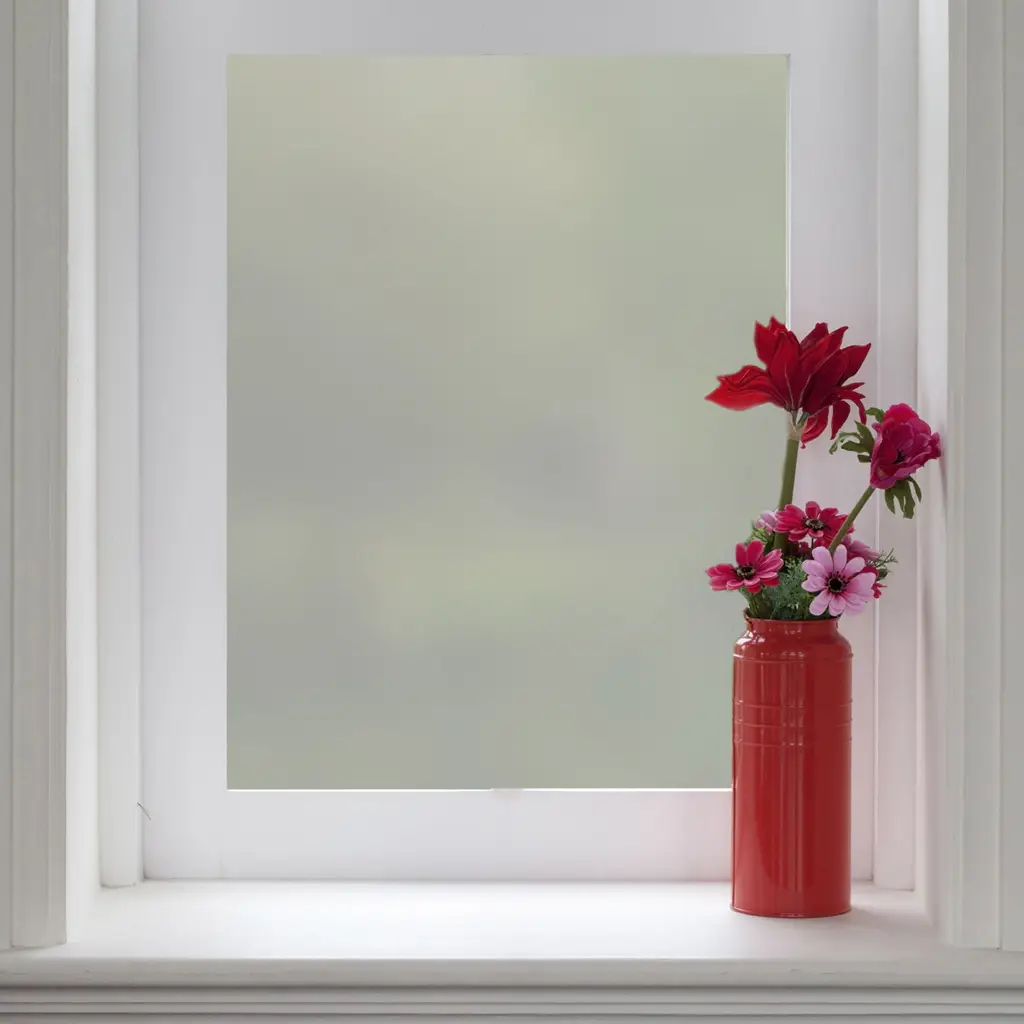
Frosted film gives consistent, 24-hour opacity from both sides of the pane, which makes it a dependable choice for spaces where confidentiality can't depend on daylight or internal lighting conditions. It's a strong fit for meeting rooms, HR offices and any glass partition around sensitive conversations or screens. Because it diffuses rather than blocks light entirely, the space still reads as bright rather than sealed. Frosted film is specified by opacity level, so the degree of obscuration can be matched to how sensitive the activity behind the glass actually is.
Reflective privacy film for daytime one-way visibility
Reflective privacy film works on a different principle. During daylight hours, with more light outside than inside, the glass appears mirrored from the exterior or corridor side while those inside retain a view out. This is well suited to street-facing offices or ground-floor consulting rooms. That said, the effect depends on the balance of light on either side of the glass, and it can reduce or reverse once interior lights are on after dark — a point covered in more detail below. Reflective privacy film is worth sampling on site before committing, given how lighting-dependent the effect is.
Coloured vinyl for total masking and brand control
Where the brief calls for complete, consistent masking regardless of time of day, coloured vinyl is the more reliable option. It fully blocks visibility in both directions and can be specified in a colour that aligns with brand guidelines, making it useful for server rooms, cash handling areas or any space where partial transparency isn't acceptable at any hour. Coloured vinyl trades some natural light diffusion for certainty, so it tends to suit smaller, more contained spaces rather than large daylight-dependent work areas.
Window privacy film for general-purpose coverage
For workspaces that need a calibrated level of obscuration without going fully opaque or fully reflective, general window privacy film offers a middle ground, available across a range of finishes and opacity levels. It's the right starting point when the brief isn't yet fully defined and the specification needs to flex between frosted, patterned or lightly tinted options.
| Film type | Best suited to | Light behaviour |
|---|---|---|
| Frosted film | Meeting rooms, HR offices, confidential workstations | Opaque from both sides, diffuses daylight, consistent day and night |
| Reflective privacy film | Street-facing offices, ground-floor consulting rooms | One-way view in daylight, effect changes after dark |
| Coloured vinyl | Server rooms, cash handling, brand-sensitive areas | Full masking in both directions, lowest light transmission |
| Window privacy film | General office partitions, flexible or undefined briefs | Variable, depends on finish and opacity level specified |
How to specify cloaking film for a security-sensitive workspace
Specifying the right film starts with understanding the space, not with picking a product. The process below reflects how this is typically approached for a secure workspace brief.
Map the sightlines. Walk the space at the times it's actually used and note exactly where someone outside the room could see in — a corridor, a reception desk, a street-facing pane.
Check lighting at different times of day. Daylight and night-time internal lighting change how privacy film performs, particularly for reflective options, so both conditions need to be assessed before a product is chosen.
Confirm the sensitivity level. Decide whether the space needs full, constant opacity (frosted or coloured vinyl) or a lighter, variable obscuration (reflective or general privacy film).
Sample before full production. A physical sample viewed in the actual space, under its actual lighting, avoids surprises once the film is fully installed.
Install and review. Once fitted, walk the sightlines again from outside the space to confirm the brief has actually been met.
A boardroom brief that needed both privacy and daylight
David Okonkwo oversees office operations for a legal practice whose partner boardroom has a glass wall facing an open-plan area. Client confidentiality meant conversations and documents on the table needed to stay private, but the partners didn't want to lose the room's daylight or its sense of openness during long meetings.
The brief ruled out blackout blinds, which the partners felt made the room feel closed and dated. Frosted film was specified instead, giving constant opacity from the open-plan side while keeping the room naturally lit throughout the day. The boardroom now meets the practice's confidentiality expectations without anyone needing to draw a blind before a sensitive meeting.
If your business is facing a similar brief — a space that needs to stay private and still feel like a normal part of the office — it's worth exploring the frosted film collection to see the opacity levels available before deciding on a full specification.
Common mistakes when specifying privacy film for secure spaces
Even a well-intentioned privacy film specification can fall short if a few practical details get missed. The most frequent issues worth checking for are below.
Assuming reflective film works the same at night as during the day. Reflective privacy film relies on there being more light outside than inside. Once office lights are on after dark, that balance can reverse. A space that was private during the day can become visible at night unless this has been planned for.
Treating all "privacy film" as equally opaque. Opacity levels vary significantly between products, and a lightly frosted finish won't deliver the same obscuration as a denser frost or coloured vinyl. The sensitivity of what happens in the room should drive the opacity level chosen, not the other way round.
Skipping the on-site sample. Colour, tint and opacity can look different once applied and lit compared with how they appear in a swatch or on screen. Sampling against the room's real lighting avoids a mismatch after installation.
A data centre that needed certainty, not a daytime effect
Priya Shah runs operations for a data centre whose control room glass faces a visitor viewing corridor used during client tours. An earlier reflective film installation worked well during the day, but staff noticed that once the control room's own lighting was on in the evening, the corridor side could see straight through.
Because the room needed consistent privacy regardless of time or visitor schedule, the film was replaced with coloured vinyl across the viewing panel, giving full masking in both directions at all hours. The space can still be opened up for scheduled client tours using a separate viewing window, specified and sampled for that purpose, rather than relying on the control room glass to do double duty.
If uncertainty about day-versus-night performance is a concern for your own site, it's worth talking through the sightlines and lighting conditions involved before choosing a product. You can book a strategy call and bring photos or a floor plan of the space to make that first conversation more useful.
FAQs on cloaking film for secure workspaces
Can cloaking film stop people seeing screens from outside a room? Yes, in most cases — frosted film and coloured vinyl are both specified to fully obscure what's behind the glass, including screens and documents, provided the opacity level matches the sensitivity of the space.
Does privacy film still work at night with the lights on inside? It depends on the product. Frosted film and coloured vinyl give consistent opacity regardless of lighting, while reflective privacy film's one-way effect depends on there being more light outside than inside, so it can behave differently after dark.
Is cloaking film permanent, or can it be removed later? Removability depends on the specific film and the surface it's applied to, so it's worth asking about this directly for your chosen product rather than assuming it either way.
Can cloaking film be combined with brand colours or signage? Yes — coloured vinyl in particular can be specified in a colour that aligns with brand guidelines, and glass manifestation or signage can often be incorporated alongside a privacy film specification where a workspace needs both security and branding addressed together.
Bringing it all together: specifying cloaking film for security-sensitive workspaces
Cloaking film for security-sensitive workspaces isn't about choosing the most opaque product available. It's about matching the right type of privacy film to the actual risk, the hours the space is used, and how much daylight the team inside genuinely needs. Frosted film suits round-the-clock confidentiality, reflective film suits daytime-only privacy where lighting allows, and coloured vinyl suits spaces that need total, consistent masking.
The process that works best starts with a proper site survey of sightlines and lighting, followed by a sample reviewed in the real space, before any film goes into full production. That sequence avoids the two most common failures: under-specifying opacity for a genuinely sensitive area, or assuming a reflective finish will behave the same after dark as it does during the day.
If you're reviewing glass partitions, meeting rooms or control areas as part of a wider security or facilities review, start with the sightlines and lighting conditions in your own space, then get those details in front of a specialist. Our offices and corporate sector page covers how this applies more broadly to workplace environments. When you're ready to talk specifics, book a strategy call and bring your floor plan or photos so the conversation starts from the real brief rather than a generic product list.
Image alt text guidance for future additions: use descriptive, hyphenated file names such as cloaking-film-security-workspace-office-partition.jpg, with alt text describing the film type, finish and sector context — for example, "Frosted cloaking film installed on a security operations centre glass partition."
Products mentioned in this article






Ready to start your project?
Discuss your requirements with a specialist and get a tailored quote for your space